
This post was drafted with the help of AI from our own commit history and reviewed by a person before publication; illustrations are AI-generated. It may contain errors and is not professional advice. Report a problem: info@delionsoft.com.
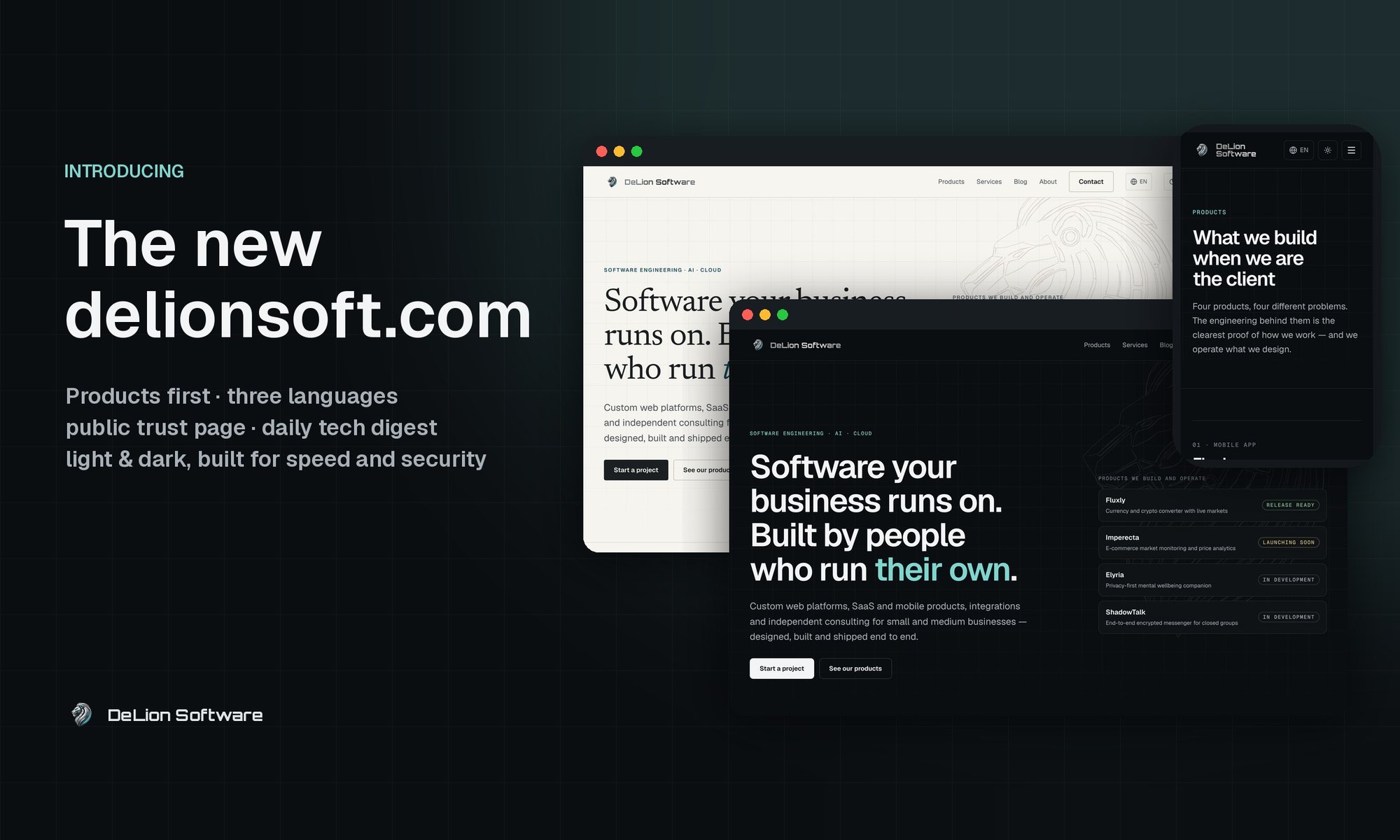
Today we are launching a new delionsoft.com. The previous site did its job for a year, but it described a company that no longer exists: a generic outsourcing agency with three service boxes and a video on every section. DeLion Software is now a product company that also takes on client work, and the website had to say that plainly. This post explains what changed, what we deliberately kept, and how we built it.
Why rebuild instead of refresh
Three things pushed us past a cosmetic update.
First, positioning. We now build and run our own software — Fluxly, Imperecta, Senvela and ShadowTalk — and that is the strongest evidence a small company can offer about how it works. The old site had no room for it.
Second, credibility. A company that advises on security should show its own practices, not just claim them. That needs a dedicated place on the site and honest wording about what we do and do not certify.
Third, reach. We work from Chișinău with clients across Europe and the CIS. One English page set was no longer enough.
What is new
Products come first. The home page opens with what we build and operate. Each product carries its current status on the products page, together with the architecture behind it. We would rather show a diagram of how Imperecta's data path works than a stock photo of a laptop.
Three services, described concretely. Software development, custom solutions and technology consulting each have their own page with scope, process, FAQ and a plain statement of what we do not do: we design DevOps and security programmes, but we do not operate your infrastructure or run your security monitoring.
Three languages. The site is now in English, Ukrainian and Romanian, with proper hreflang so search engines serve the right version. Legal documents stay in English, which remains the binding version.
A public trust page. /trust lists the engineering practices we follow on every project, which subprocessors handle this website's data, our vulnerability disclosure policy, and — explicitly — the certifications we do not hold yet. security.txt is in place for researchers.
Orbit. This blog is now Orbit. Its Radar rubric is a curated digest of news that matters to small and medium businesses and their engineering teams: security advisories, platform changes, credible AI developments. Each post is written in our own words by Ion, Orbit’s editor, and always links to the original source. The rules are strict — no invented facts, no long quotations, no hype — and new posts appear on weekdays.
A design system with two skins. The site has a light "editorial" look and a dark "engineering" look, switched by your system preference or a toggle in the header. One layout, two characters. The only element carried over from the old identity is the wordmark — its flowing-silver effect was worth keeping.
No video, better numbers. Background videos are gone. The visual layer is line art: a lion traced from our logo that emerges from the hero grid, hairline product diagrams, topical covers on blog posts. The result loads faster on a phone than the old site did on a desktop.
What we built it with
Next.js 16 on Vercel, TypeScript throughout, Tailwind CSS with design tokens for both skins, Markdown content in the repository. Every response carries a strict Content-Security-Policy with a per-request nonce, HSTS, and the usual hardening headers. The contact form is protected by a client-bound signed token, a proof-of-work challenge solved silently by your browser, and rate limiting. Dependencies are pinned in a lockfile.
We are stating this level of detail on purpose. If you are evaluating us as a partner, the site itself is a sample of the work.
What did not change
The company, the people and the contact details are the same. Existing links to the old service pages redirect to their new equivalents. Our privacy policy and terms are unchanged.
What comes next
Radar is our industry news rubric — the posts are on the blog. If something on the new site is unclear, broken or simply wrong in your language, tell us — the fastest way is the contact page. We read everything.